Texture Consolidation
Project page for "Texture Consolidation of Generated Multi-View Renderings"
Texture Consolidation of Generated Multi-View Renderings
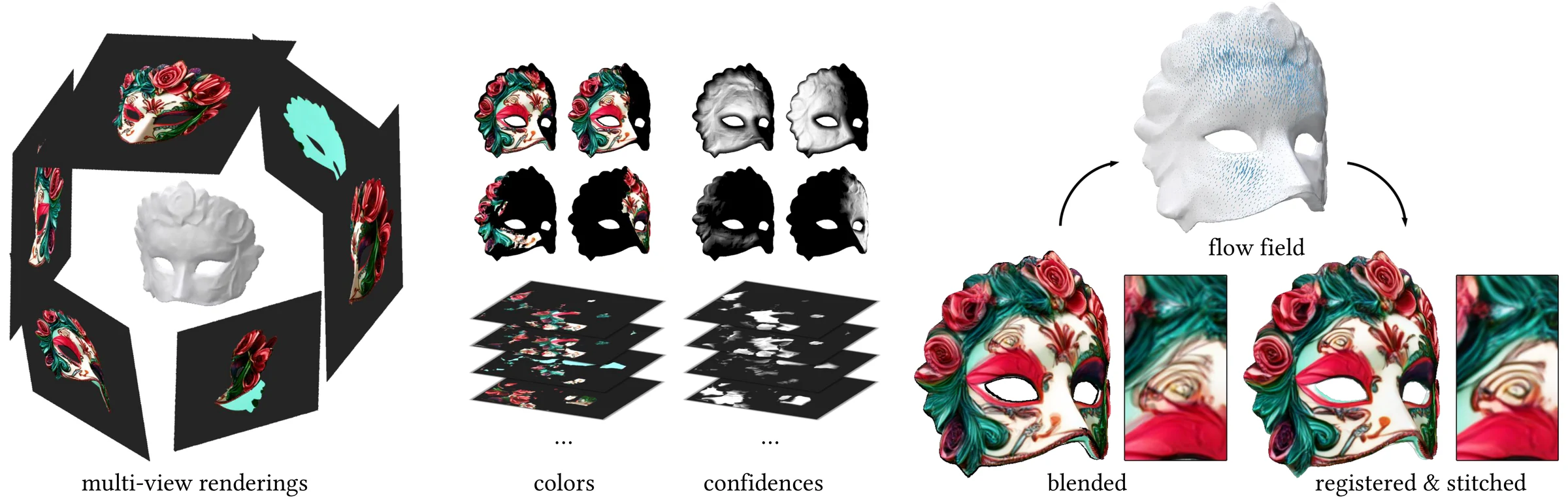
Input A sparse set of generated multi-view renderings with known cameras (left), together with a texture-atlased mesh.
We back-project the renderings into texture-space colors and confidences, register them with flow-fields solved on the surface, and fuse them by confidence-aware gradient-domain stitching.
Output A single seamless texture image, shown rendered on the mesh (right). Confidence-weighted blending alone ghosts; registration and stitching keep the detail sharp.
Abstract
We present a system for consolidating a sparse set of multi-view renderings into a single coherent texture image, providing a framework for integrating generative models for image generation within the geometry-processing pipeline. Given a texture-atlased triangle mesh and a set of renderings with associated camera parameters, we generate the texture image by: (1) back-projecting the renderings onto the mesh to obtain texture images with normalized colors and confidences; (2) solving for flow-fields on the mesh that align the colors to each other, taking into account the associated confidences; and (3) fusing the registered colors into a single texture image using gradient-domain stitching, again incorporating confidences. Our approach complements existing techniques for multi-view image generation, leveraging mesh-based optical flow and texture-space stitching. In doing so it addresses the challenge that while modern image generation pipelines generate highly convincing renderings, they struggle to produce renderings that are consistent across views.
Results on Real Photographs
Here we show the example run from our code release, with nine photographs of a vase as input.
Drag to rotate, scroll or pinch to zoom, and drag the divider to compare Blended on the left with Ours on the right.
Loading the 3D model…
Results on Generated Renderings
The following image shows the front view of three objects, each textured from nine generated renderings. Note that the front view is not one of the nine inputs.
Use Highlights to step through the regions the paper zooms into, or Free zoom to magnify whatever is under the cursor. The row under the image shows every method at the same spot. Click one to place it beside ours.
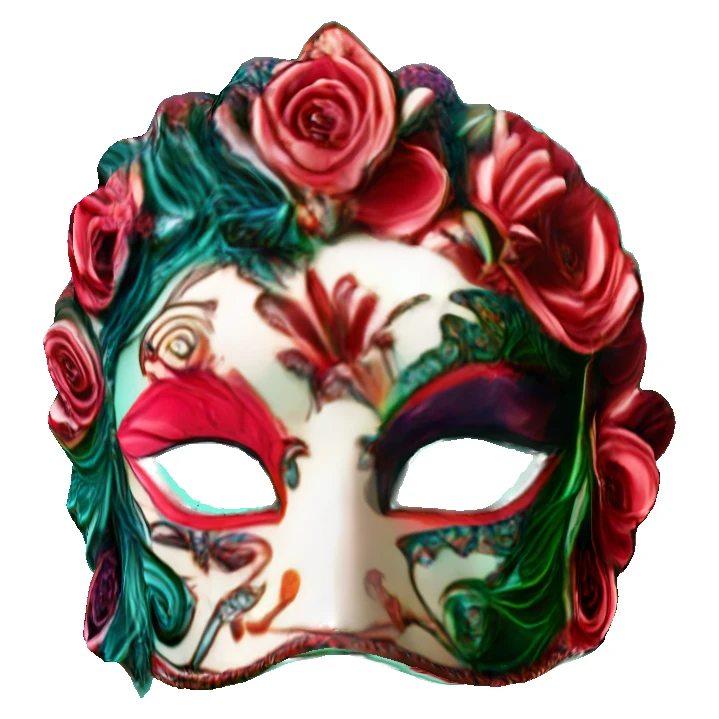
Fusing misaligned renderings directly leaves ghosting and blur. Selecting one view per patch, as MVS-tex does, stays sharp inside each patch but leaves seams where patches meet. Methods designed for dense RGB-D captures, such as ColorMap and AdvIA, degrade on a sparse set of inputs. Our method registers the renderings on the surface before fusing them, producing a seamless, ghost-free texture.
BibTeX
If you find our work useful, please consider citing:
@misc{liu2026texture,
  title         = {Texture Consolidation of Generated Multi-View Renderings},
  author        = {Liu, Hongyi and Wang, Yifan and Kim, Vladimir G. and Kazhdan, Misha},
  year          = {2026},
  eprint        = {2610.36098},
  archivePrefix = {arXiv},
  primaryClass  = {cs.GR},
  url           = {https://arxiv.org/abs/2610.36098}
}